
Behind the Research: How Flyover Country Challenges Coastal Narratives
When people think about LGBTQ+ history in the United States (if they think about it at all), the story often begins and ends on the coasts. New York. San Francisco. Los Angeles. Washington, D.C. These places matter, but they are not the whole story.
Flyover Country was created to confront a quiet assumption embedded in many “progress narratives”: that queer liberation happened primarily in major coastal cities, while the rest of the country lagged behind or merely followed along. As a public historian, I knew that story was incomplete. As a Midwesterner, I knew it was wrong!
This exhibit exists because the Midwest matters and because regional queer history has been systematically overlooked, not absent.
The Question That Started It All
The seed for Flyover Country was planted in a surprisingly ordinary moment: mowing the lawn. Like many people interested in LGBTQ+ history, I spend hours listening to podcasts about Stonewall, Harvey Milk, Frank Kameny, the Mattachine Society, and the birth of gay liberation. Over time, a pattern emerged.
Every story seemed to take place on the coasts and every expert appeared to be speaking about the places where they lived. But I was taught about the importance of primary source research and creating an understanding of where you are. Queer activism wasn’t confined to port cities, but by simply listening to the loudest microphones, I was skipping over the middle of the country—the part that I live in!
The need for an exhibit like Flyover Country became obvious once I stopped asking, “Why isn’t anyone talking about what happened here?” and started asking, “Why am I not?”
Researching Against the Grain
The research methodology behind Flyover Country intentionally pushes against conventional historical shortcuts. Instead of relying solely on nationally syndicated newspapers or well-known archives, this exhibit draws from:
Local and regional newspapers
Student journalism
Oral history interviews
Community newsletters and underground presses
Court records and legislative archives
LGBTQ+ archives housed in Midwestern universities and historical societies
This matters because many pivotal moments in Midwest LGBTQ+ history were never meant for a national audience. They were documented locally, often by people who didn’t yet know they were “making history.”
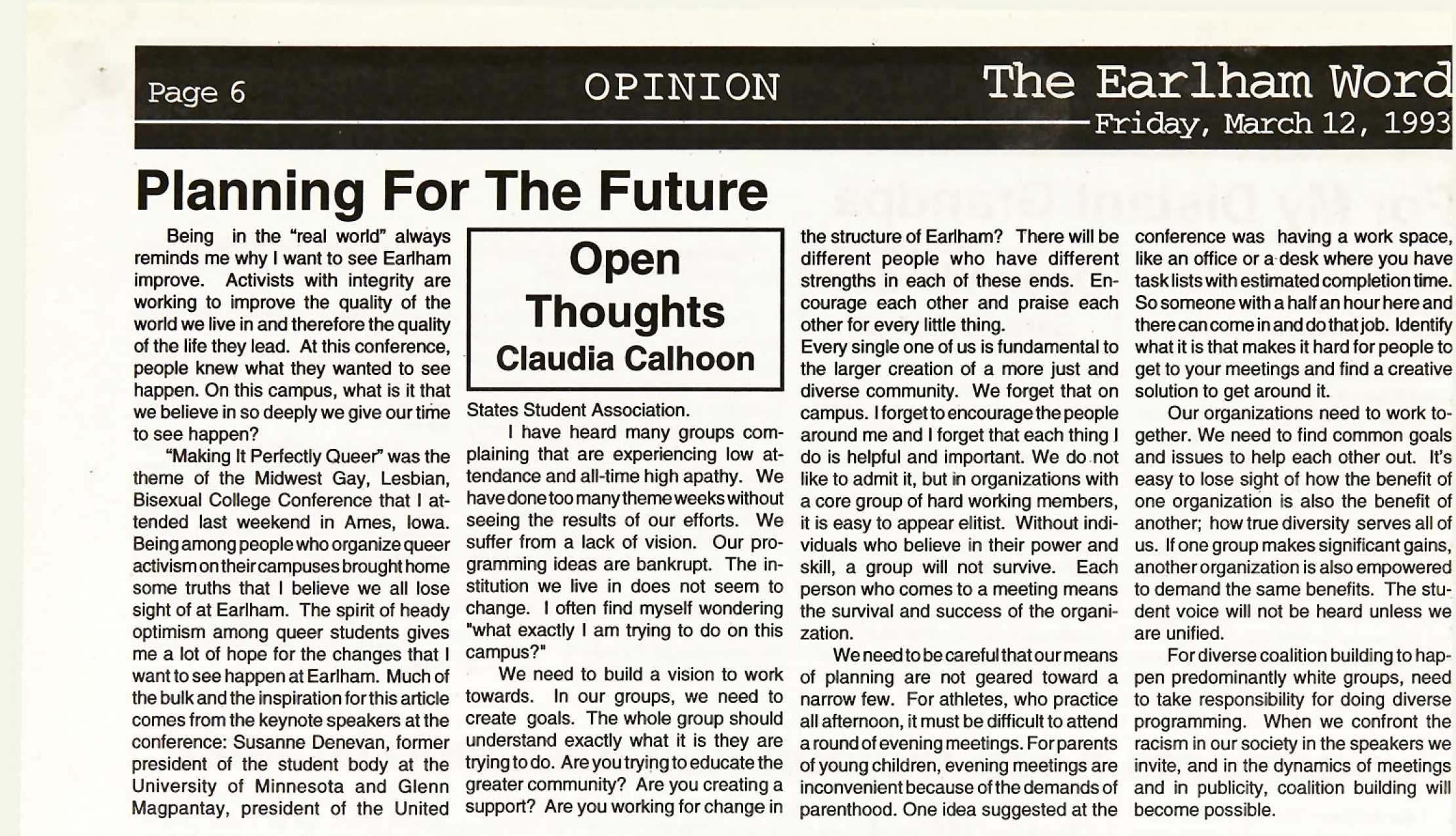
An opinion column by an Earlham College student in their student newspaper who attended the first annual Midwest Gay, Lesbian, Bisexual College Conference in Ames, Iowa
Student newspapers, in particular, emerged as a recurring goldmine. Again and again, student activists were among the first to organize, publish, and document queer life—long before mainstream institutions either existed or took notice.
The Power of Place
Historian Brice D. Smith’s research makes clear that in Milwaukee, the Gay People’s Union (GPU) was not a social footnote—it was a fully functioning liberation organization that provided educational outreach, worked with government officials, hosted cultural events, and created space outside of bars for political conversation.
Smith’s work on the life of Lou Sullivan, a FTM transgender pioneer who lived in San Francisco by his death, is instructive because before Lou Sullivan became a foundational figure in the international FTM community, he honed his organizing skills in Milwaukee through GPU.
Smith writes: “In reclaiming and reconstructing the history of the Gay Liberation Movement historians have focused almost exclusively on the east and West coasts of the United States suggesting by omission that the movement only existed on the geographical margins of this country…”
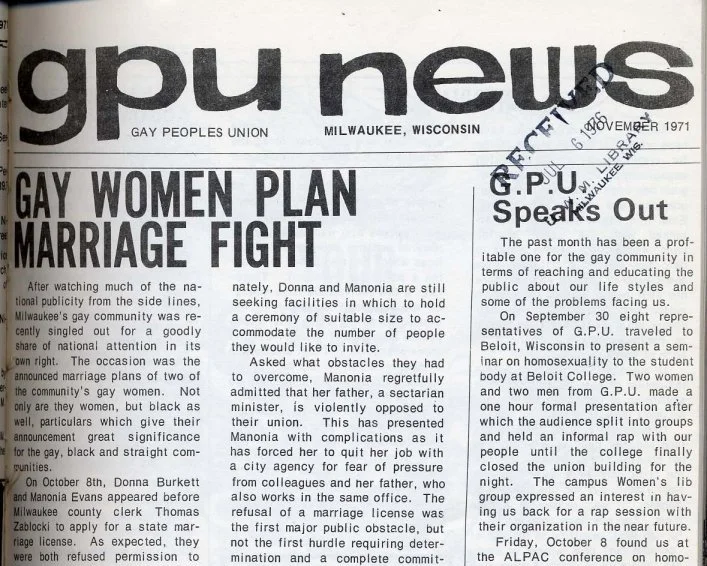
Same-sex marriage was an issue in America’s Heartland decades before the national dialog kicked up in 1990
Milwaukee’s GPU—rooted in the University of Wisconsin–Milwaukee’s earlier Gay Liberation Organization—was one of hundreds of such groups nationwide. Their absence from popular memory is not evidence of inactivity. It’s evidence of historical neglect.
Oral History as Corrective Lens
Oral history plays a central role in Flyover Country because it captures what traditional archives often miss: motivation, strategy, and lived experience.
The first oral history interview I conducted in 2026 was with one of Milwaukee’s LGBTQ+ elders, a 77-year-old activist, who articulated why community spaces beyond bars were so critical: “Gathering gays outside of the bar; that’s why the need for the community center was so obvious… You needed someplace other than a pick-up joint to talk about pronounced issues in our community.”

The University of Michigan in Ann Arbor was the first campus-run LGBT Student Center, and its successor started the Lavender Graduation tradition now celebrated around the country.
That perspective reframes how we understand organizing. Bars may have been flashpoints, but sustained movements required meeting rooms, newsletters, coalitions, and political education. Those infrastructures existed across the Midwest—often earlier than we’ve been taught to believe.
Midwest “Firsts” That Rewrite the Narrative
Flyover Country highlights a series of documented “firsts” that force a recalibration of LGBTQ+ history:
Organizing for Liberation: The first chartered gay rights organization (Society for Human Rights, Chicago, 1924) and the first national homophile conference (NACHO, 1966).
Protecting from Discrimination: Illinois decriminalizing sodomy in 1961; Minnesota outlawing discrimination decades before it was politically safe to do so elsewhere.
Brawling for Safe Spaces: A pre-Stonewall uprising at Milwaukee’s Black Nite in 1961, preserved through transgender oral history interviews and local press.
Marching for Visibility: Chicago’s 1970 march commemorating the Stonewall Riots preceded the New York march that led to the national mythologizing of Pride’s origins.
Teaching and Learning: Kinsey’s Midwestern research, early campus centers, and student organizations. The birth of the Midwest Bisexual Lesbian Gay Transgender Asexual College Conference in Iowa was documented almost exclusively through student journalism.
Tying the Knot: Early marriage license applications in Minnesota and Milwaukee, preserved through court records, oral histories, and local media.
Running for Office: From school boards to Congress, Midwest candidates repeatedly broke ground long before national headlines followed.
None of this history is speculative. It is supported by archival evidence that’s often sitting quietly in local collections for decades.
Why Coastal Bias Persists
So why does the coastal narrative still dominate?
Part of the answer lies in media concentration, publishing pipelines, and academic prestige. Another part is loss. HIV/AIDS wiped out an entire generation of activists—many of whom returned to the interior of the country to die, taking untold stories with them.
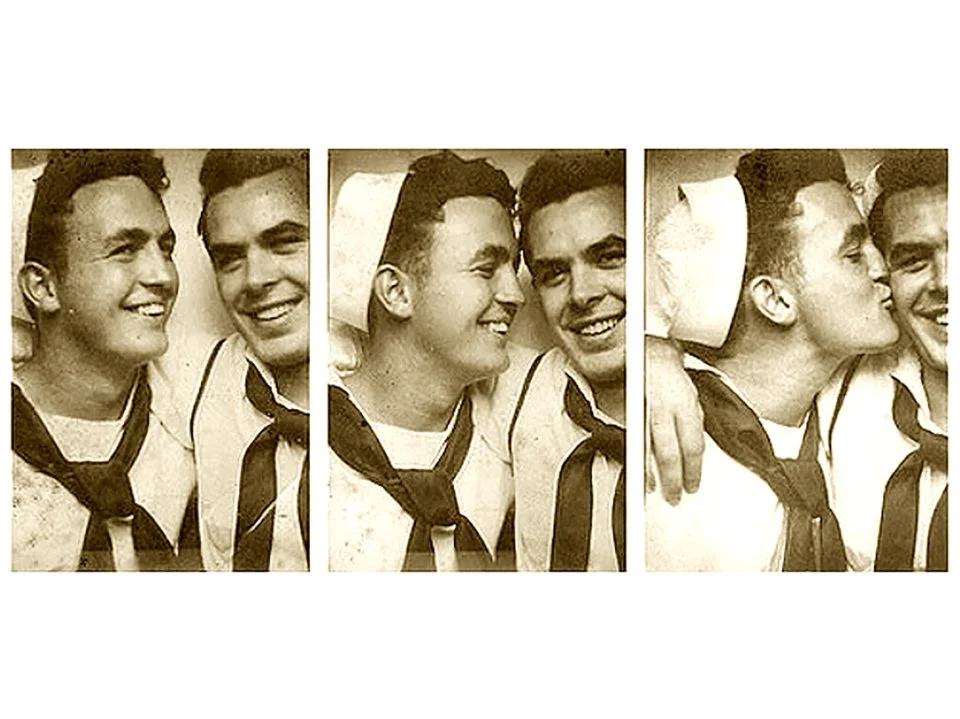
Two unknown American sailors in a photo booth, Friends of the National WWII Memorial
Progress narratives also tend to favor cities tied to trans-oceanic trade, military deployment, and global visibility. That bias leaves rural and Midwestern activism framed as “behind,” rather than different, or just as often, deeply intersectional.
The Value of Reclaiming the Middle
The Flyover Country exhibit does more than correct the record; it provides institutions with a research-driven, accessible framework grounded in primary sources that connects local audiences to national movements through place-based history. By proving that LGBTQ+ history belongs in every community—not just in major coastal museums—the exhibit offers a vital framework for discussing activism, resistance, and progress beyond traditional stereotypes.
For libraries, schools, Pride festivals, and civic spaces, Flyover Country invites audiences to see themselves as part of the story—not footnotes to someone else’s.
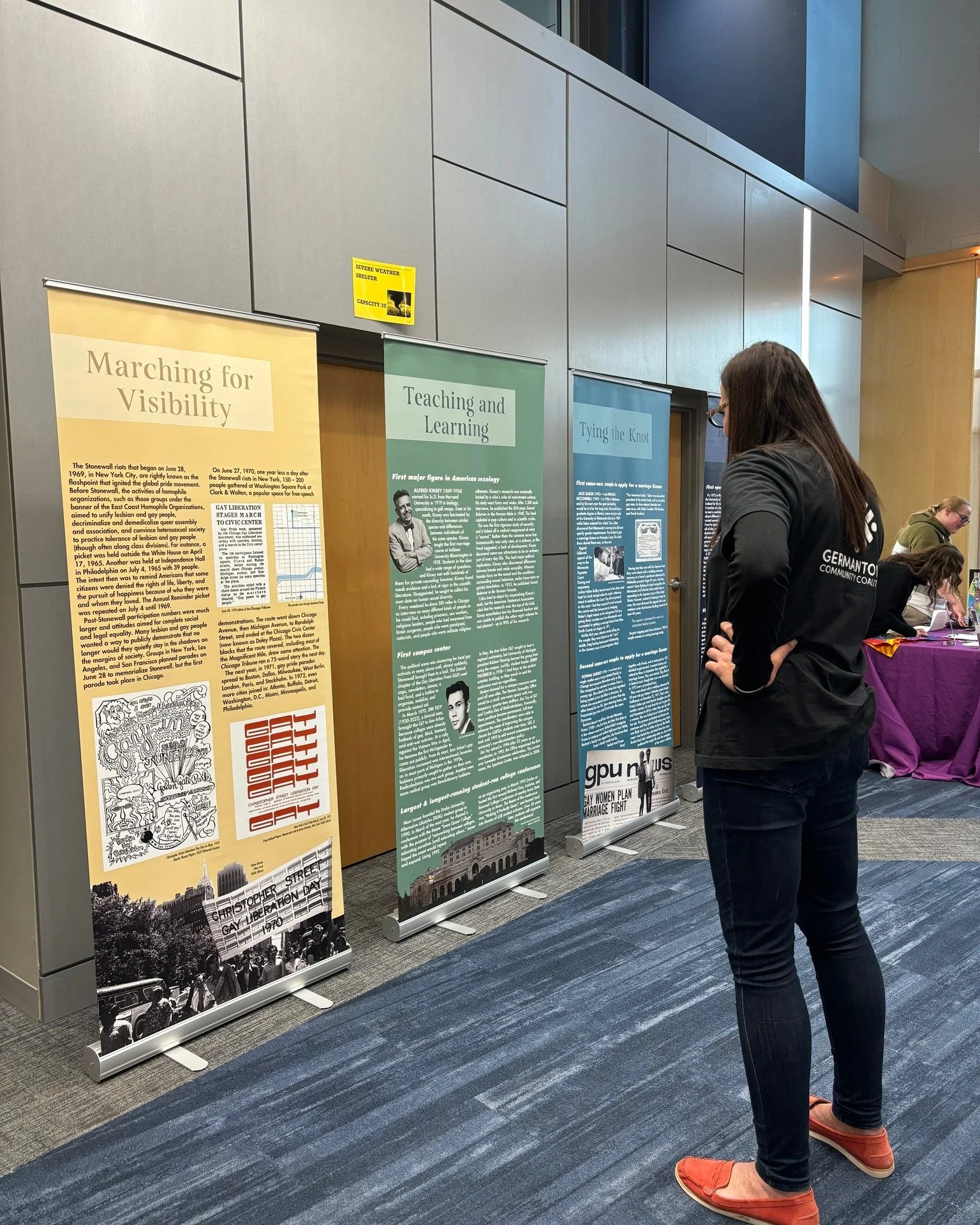
The Midwest has never been empty. It has never been passive. And it has never been absent from LGBTQ+ history.
Flyover Country exists because regional queer history deserves the same care, rigor, and visibility as any coastal narrative. When we widen the lens, we don’t diminish Stonewall or Harvey Milk—we enrich them by placing them within a truly national movement.
If you’re ready to challenge assumptions and bring this history to your audience:
Bring Flyover Country to your community — contact vince@ExpandingHorizons.LGBT
