
Why City Halls Should Display LGBTQ+ History Year-Round (Not Just During Pride)
The National Endowment for the Arts has long operated under a simple, clarifying principle: a great nation deserves great art. It's a statement about what public institutions owe the public they serve — more than basic functional services, a nation requires cultural investment, meaning, and recognition.
The civic equivalent for municipalities is equally clear: a great city establishes, through its public spaces and public institutions, that every resident belongs here. Not just during designated months. Not just symbolically. Year-round, substantively, and in the places that carry the most institutional weight.
City Hall is one of those places. And for LGBTQ+ residents, particularly youth, what happens in that building, and on its walls, and in its lobbies, sends a message about whether their government sees them.
The Difference Between a Symbol and a Statement
In March 2026, Idaho Governor Brad Little signed legislation imposing fines of $2,000 per day on cities that flew flags not on the state legislature's pre-approved list. Minutes after the bill was signed, the city of Boise removed the Pride flag that had flown in front of its City Hall for more than a decade.
Boise Mayor Lauren McLean was direct about what the moment meant: despite the efforts taken by the Legislature, the values and spirit of the city won't change — cannot be changed. Boise's City Council President added that the commitment to every person who had looked at that flag and felt seen did not waver for a single moment.
What happened in Boise is a clarifying case study in the limits of symbolic civic inclusion, and a powerful argument for something more durable. A flag is a symbol. It can be legislated away. But a traveling historical exhibit displaying documented LGBTQ+ history — the people, the movements, the civil rights battles fought and won and fought and lost — is substantive educational content. It tells a complete story rather than representing one. It is, by definition, harder to target and more difficult to dismiss.
Cities that want to make a genuine, defensible civic commitment to their LGBTQ+ residents have a more powerful tool available to them than a flag. They have history.
What San Diego Got Right
In October 2025, the city of San Diego installed a landmark LGBTQ+ history exhibit in the lobby of City Hall; it was a collaboration between the LGBTQ Historic Task Force, Lambda Archives of San Diego, the San Diego History Center, and the San Diego Museum Council. The exhibit showcased artifacts, photographs, and personal stories tracing decades of LGBTQ life in the city, from early activism and cultural milestones to the AIDS crisis and beyond.
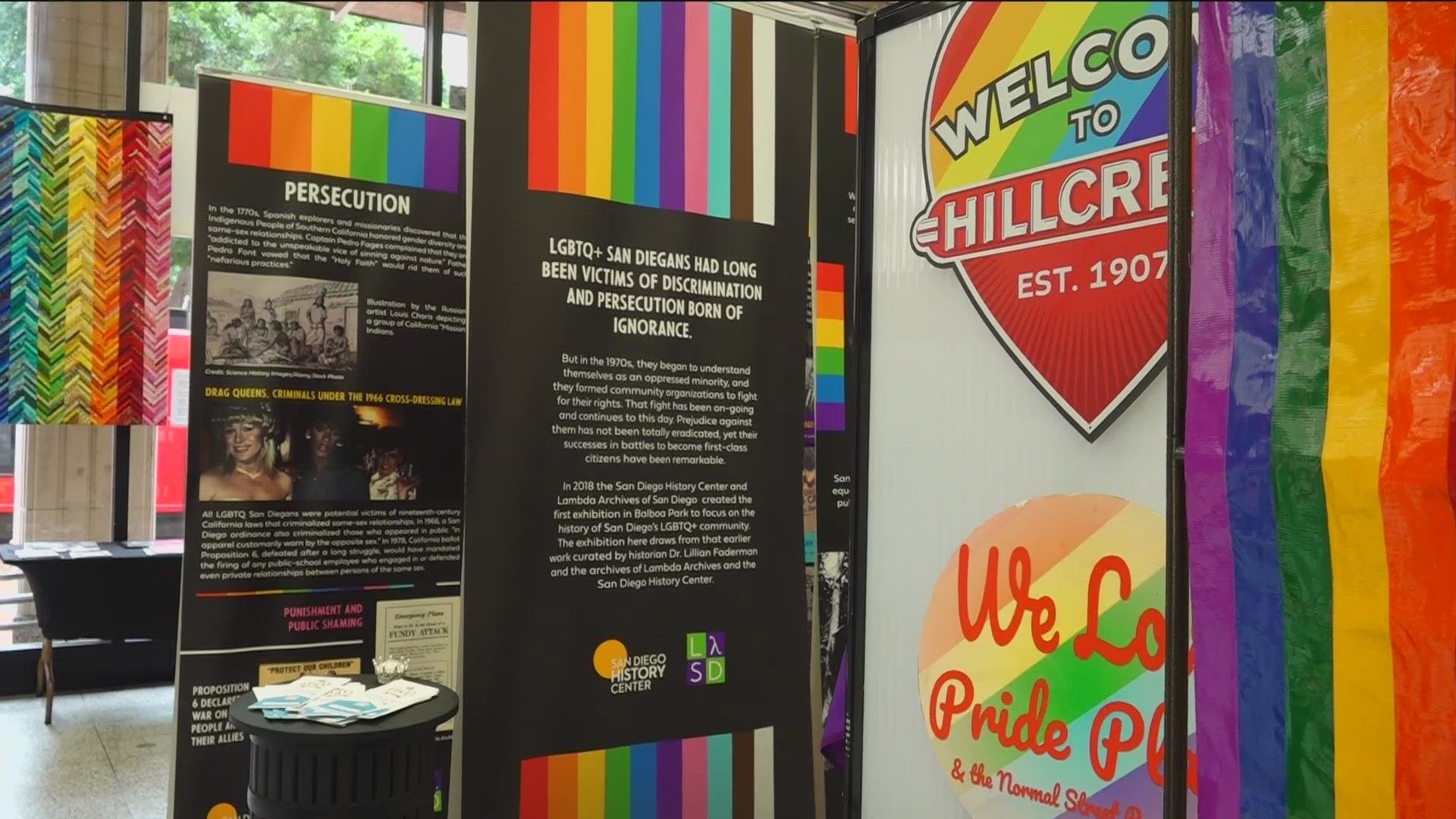
Community advocate Nicole Murray Ramirez offered a precise summary of what this kind of programming accomplishes: "A community that does not know its history — or the leaders who came before it — cannot truly understand its path forward."
That sentence contains the entire argument. City Hall is not just an administrative building. It is, for many residents, their most direct point of contact with local government — the place where they come to file paperwork, attend public meetings, pay fees, and experience, in the most literal sense, what it feels like to be recognized by their government. What is on those walls communicates something. The question is whether municipalities are making that choice deliberately.
Why Year-Round Matters
The case for year-round display, rather than Pride Month installations, is both practical and principled.
On the practical side: LGBTQ+ residents, and particularly LGBTQ+ youth, exist year-round. The questioning teenager walking through a city hall lobby in February receives no message from a display that went up in June and came down in July. The trans adult navigating a bureaucratic process in October encounters only the default — which, in the absence of deliberate representation, communicates its own message.
On the principled side: limiting LGBTQ+ visibility to Pride Month inadvertently reinforces the idea that queer identity is seasonal — a celebration that gets its designated time and then steps back. Year-round display communicates something fundamentally different: that LGBTQ+ history is American history, civic history, local history, and that it belongs in the same permanent conversation as every other part of the community's story.
This is what it means for a city to establish civic inclusivity rather than perform it.
History as Civic Infrastructure
The most effective LGBTQ+ history programming in civic spaces doesn't function as decoration. It functions as infrastructure — connecting residents to the documented record of their community's struggles and contributions, creating intergenerational recognition, and providing the kind of context that helps every visitor, LGBTQ+ or not, understand what civil rights actually cost and how they were won.
This is the frame that should guide municipal decision-making. The question isn't whether to include a Pride flag in June. It's what kind of educational and civic environment a city is actively building for its residents across all twelve months — and whether LGBTQ+ history has a permanent place in that environment, or only a borrowed one.
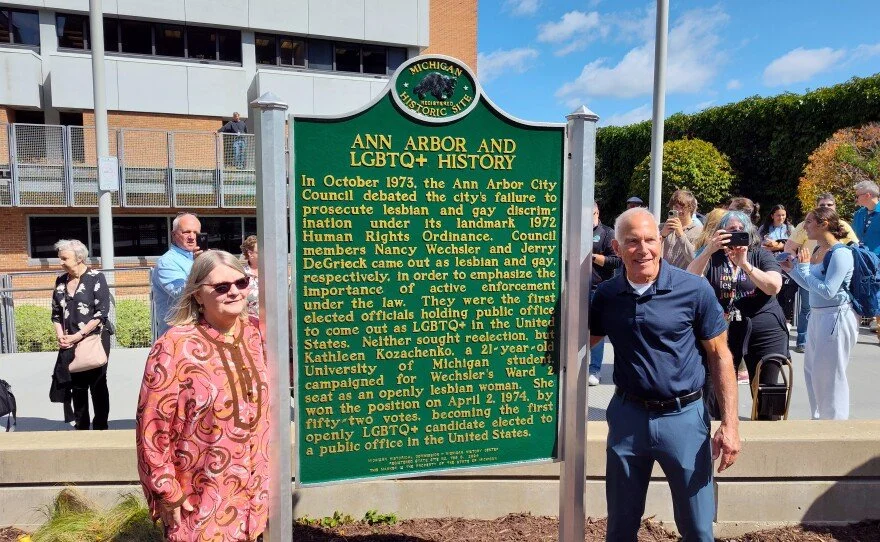
Kathy Kozachenko (right), who is featured in the Flyover Country exhibit, poses with a Michigan Historic Site sign.
Progressive municipalities are already recognizing that the answer to legislative hostility isn't retreat. It's depth. A flag can be mandated away. An exhibit that documents 75 years of civil rights history, displayed in a public building, representing a community that has always been part of the fabric of that city, is a different kind of civic commitment entirely.
Make Your City Hall a Year-Round Statement
Expanding Horizons' traveling exhibits are designed precisely for civic spaces — city halls, libraries, community centers — and available for multi-week or extended installations that go well beyond the Pride Month window. They install cleanly, require no permanent infrastructure, and create the kind of programming that residents remember and that local media covers.
Ready to make your city hall a year-round statement of civic inclusion? Contact Vince to discuss installation options and explore the full exhibit catalog at ExpandingHorizons.LGBT/exhibits.
A great city doesn't just celebrate its LGBTQ+ residents in June. It recognizes them every time they walk through the door.
