
Marsha P. Johnson and Sylvia Rivera: The Trans Women Who Started a Revolution
There’s a version of this story that has become almost liturgical. Two trans women of color throw the first bricks at Stonewall… A movement is born… Their names become sacred... The story ends.
But Marsha P. Johnson and Sylvia Rivera deserve better than sainthood. They deserve honest history, which means grappling with what they actually did and why the work that came after Stonewall may matter more than any single brick ever thrown.
A Word About Words
Before I tell their story, a necessary historical note: the word “transgender” as a social identity, a community category, a political framework did not yet exist while Marsha and Sylvia were alive in the way we use it today. Sylvia identified as a drag queen, a queen, a transvestite, and as a “half-sister” while using her birth name and masculine pronouns during her lifetime.
This matters not as a correction but as a context. When we retroactively apply today’s categories to people from the past, we risk making their lives legible to us at the expense of understanding the world as they actually navigated it. They were breaking new ground; they were not proto-versions of a modern identity. They were themselves in their time, in their language, with their own hard-won self-understanding.
At and after Stonewall
Marsha P. Johnson
What the historical record does show, from multiple independent accounts gathered by historian David Carter in his exhaustive research on the uprising, is that Marsha P. Johnson was almost certainly among the people to push back physically against the police in the early morning hours of June 28, 1969. However, Johnson herself clarified in interviews that she did not arrive until the place was already on fire. So, she did not throw the proverbial first brick. She was there, though, and that does matter.
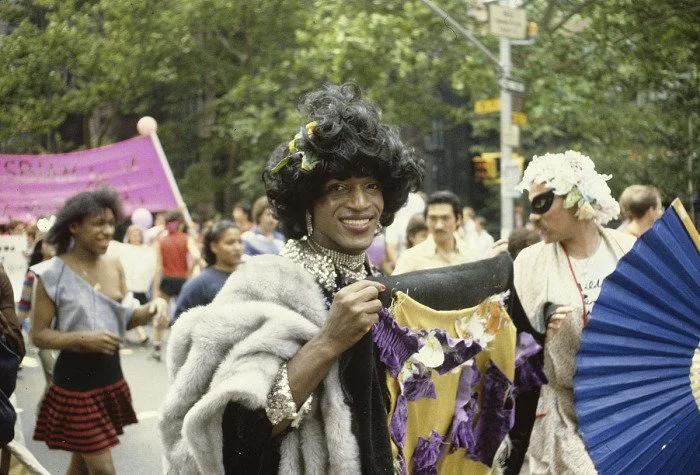
Marsha P Johnson in Manhattan by Ron Simmons, 1982.
Sylvia Rivera after Stonewall
Sylvia Rivera’s relationship to the Stonewall uprising itself is more complicated — and the historical record, as Carter documents it, raises serious questions about whether she was present on the first night at all. Her own accounts shifted over the years, and Marsha told their mutual friends that Sylvia had not been there at the start.
A committed reader of honest history has to hold that complexity. Accepting it isn’t a diminishment of Sylvia Rivera; it’s a recognition that her actual contributions to the movement — which were enormous, sustained, and made at great personal cost — do not require a founding myth to be legitimate.
What Rivera did after Stonewall is the real story.
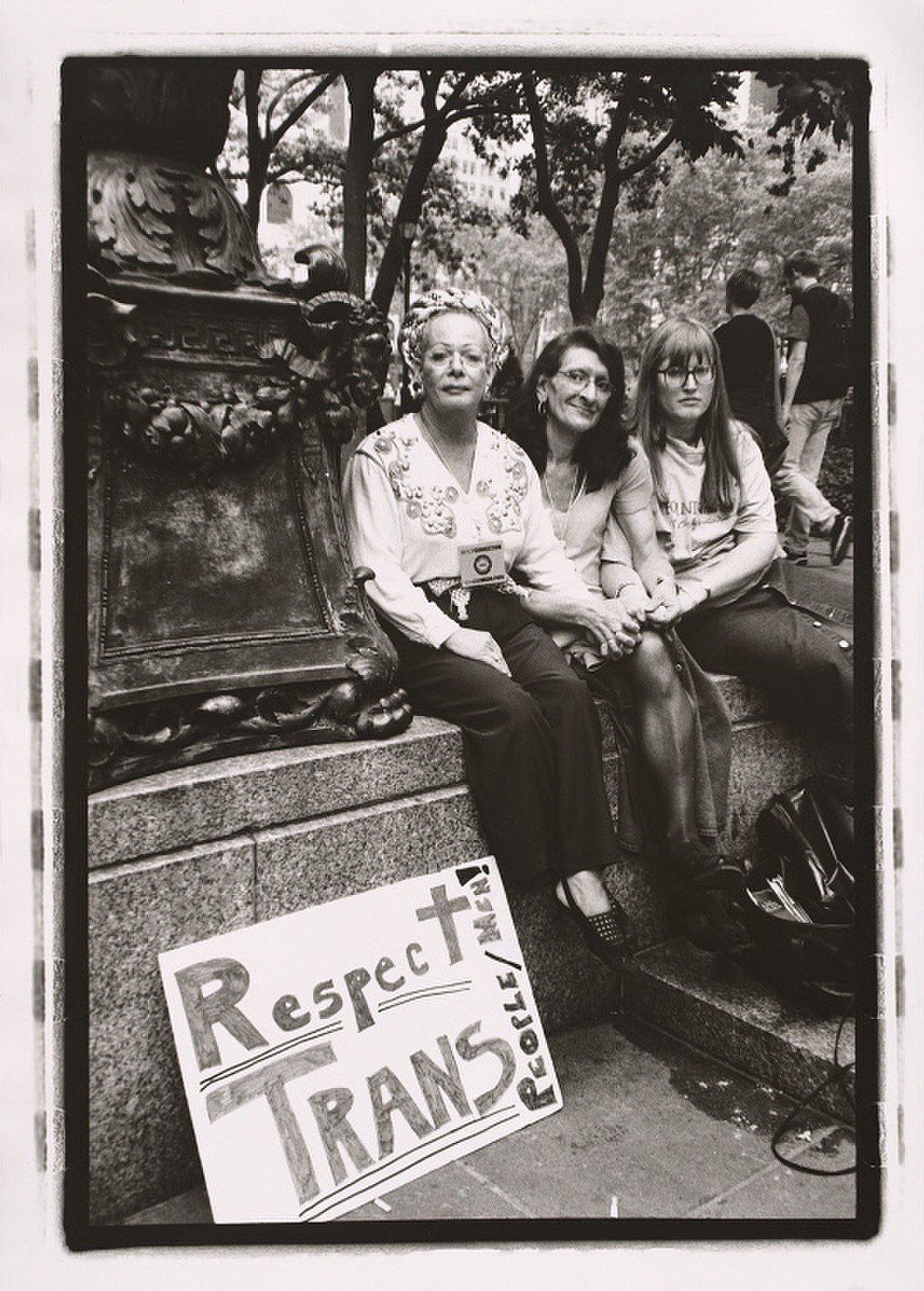
Sylvia Rivera (middle) by Luis Carle, 2000.
What They Built: STAR House
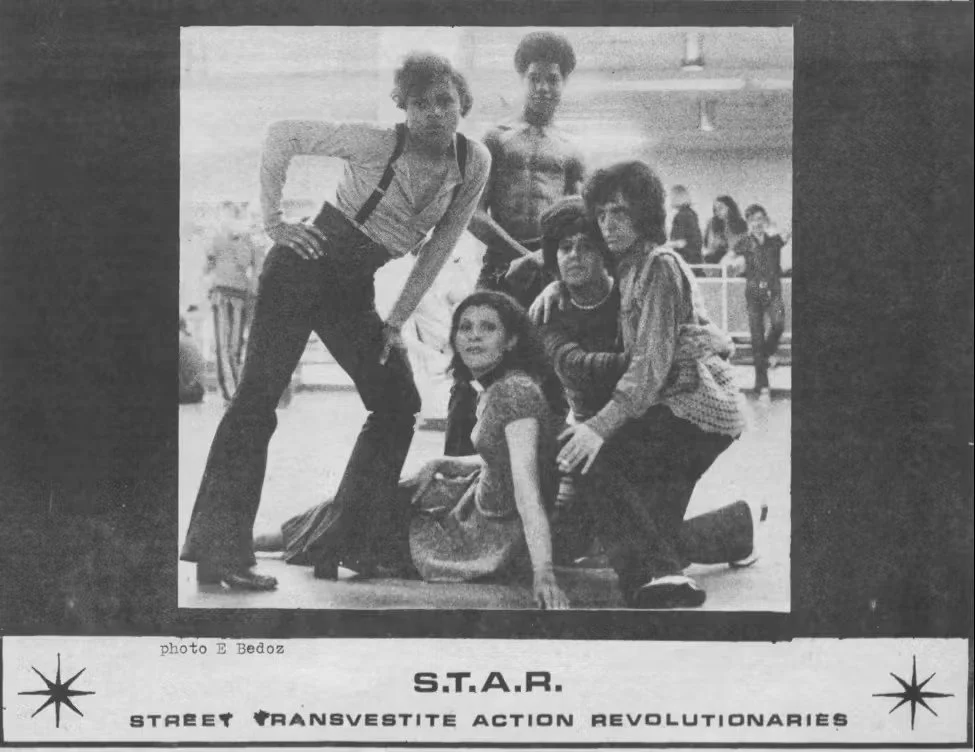
In 1970, Johnson and Rivera founded Street Transvestite Action Revolutionaries (STAR) and with it, one of the most radical acts of mutual aid in the history of the LGBTQ+ movement. They started with a parked trailer truck in a Greenwich Village parking lot, housing the young people who had already been squeezed out of civil society: street youth, runaways, trans kids who had been cast out by their families and had nowhere else to go.
When the truck was towed, they found a building at 213 East 2nd Street, a tenement in disrepair with no electricity, no plumbing, no working heat. They fixed it themselves and they fed people and they kept the lights on by any means available to them. They envisioned using the upper floors as a school to teach residents who had been forced out of their homes before they could learn to read and write. Rivera later reflected that young people came to STAR House from as far away as Boston and California.
STAR House was the first LGBT youth shelter in North America, the first trans woman of color-led organization in the United States, and the first trans sex worker labor organization. It lasted eight months before they were evicted for unpaid rent. The building was eventually demolished.
Eight months! It only lasted eight months, yet it was the first of its kind in the country.
Heroic Actions, Not Heroes
Here is what tends to get lost when Marsha and Sylvia are elevated into icons: they were ordinary people surviving in hostile conditions, who repeatedly made extraordinary choices at great cost with no guarantee that anyone would remember. To me, that story is more relatable than the hagiography.
Marsha P. Johnson spent years navigating poverty, homelessness, grief, mental illness, and the casual violence the world directed at someone like her. Sylvia Rivera spent much of her life in conflict with the police, with addiction, with feminist and gay organizations that wanted a more palatable face, with a movement that was built on the backs of people like her and then asked them to step back for strategic reasons. She was famously booed off a stage at a 1973 Pride rally by a crowd that didn’t want to hear what she had to say, but she persisted and gave voice to the conscience that the movement needed.
Neither of them was a saint, but neither of them needs to be. What they were was human. In the face of a system that wanted them invisible, they insisted on being seen, and they built something real for the people forgotten by the world, and even the rising gay liberation movement.
The history is more powerful than the mythology.
An Uncomfortable Footnote
There is something worth sitting with in how Marsha and Sylvia have been taken up in recent years by activists of all stripes… images on Pride merchandise, names in inclusion training slides, lists of pioneers of LGBTQ+ leaders… their stories used as feel-good wallpaper for brands that would not have crossed the street for them when they were alive. Trans sex workers who participated in a riot against police are not, on their face, the obvious mascots of Fortune 500 DEI initiatives. The gap between who they were and how they’ve been branded tells us something important about how the story truth can swallow the happening truth whole.
The real Marsha P. Johnson and Sylvia Rivera — complicated, defiant, brilliant, struggling — are more useful to us than the laminated versions. Because they show us what it actually looks like when ordinary people decide to stop waiting for a movement that fits them and build one instead.
Learn More
Expanding Horizons’ The Stonewall Inn exhibit brings the full complexity of the uprising — and the people who made it — to communities across the country. If you want your audience to encounter not the myth but the history, this is where that conversation begins.
Explore TheStonewall Inn exhibit and plan your booking at ExpandingHorizons.LGBT/exhibits.
They built something with what little they had, and so can we. How empowering is that!
