
Every June, the debate resurfaces like clockwork. Is Pride a party or a protest? A celebration or a political act? Should it be joyful or angry, inclusive or radical, corporate-sponsored or community-owned?
The debate is understandable. It is also, ultimately, a false binary. The last 75 years of history tells us why.
The more urgent question — the one that actually has an answer — is this: what turns a moment of visibility into a movement with staying power? Because anger can ignite a moment. But only institutionalization makes it a movement. And the difference between the two is where every generation of LGBTQ+ people has had to do its most difficult work — including the work of reckoning with what institutionalization costs.
Visibility Is a Tool
We talk about visibility as though it were self-evidently good, a goal in itself, something to be achieved and then possessed. But visibility is better understood as a tool. And like any tool, its value depends entirely on what you build with it.
Looking back across 75 years since the founding of the Mattachine Society in 1950 to the present reveals that visibility has served at least three distinct functions, each more demanding than the last.
The first is internal. Before visibility could change the minds of outsiders, it had to shatter the weaponized isolation that kept LGBTQ+ people from finding each other. The state, the medical establishment, and the mainstream media worked in concert throughout the mid-20th century to enforce a narrative: that being queer was rare, hidden, and shameful. A few dozen people marching in the early homophile pickets of the 1960s were not going to change federal policy. But they were sending a signal to every person watching from a window or reading a newspaper account: you are not alone. Visibility's first job is always to find the people who think they are the only one.
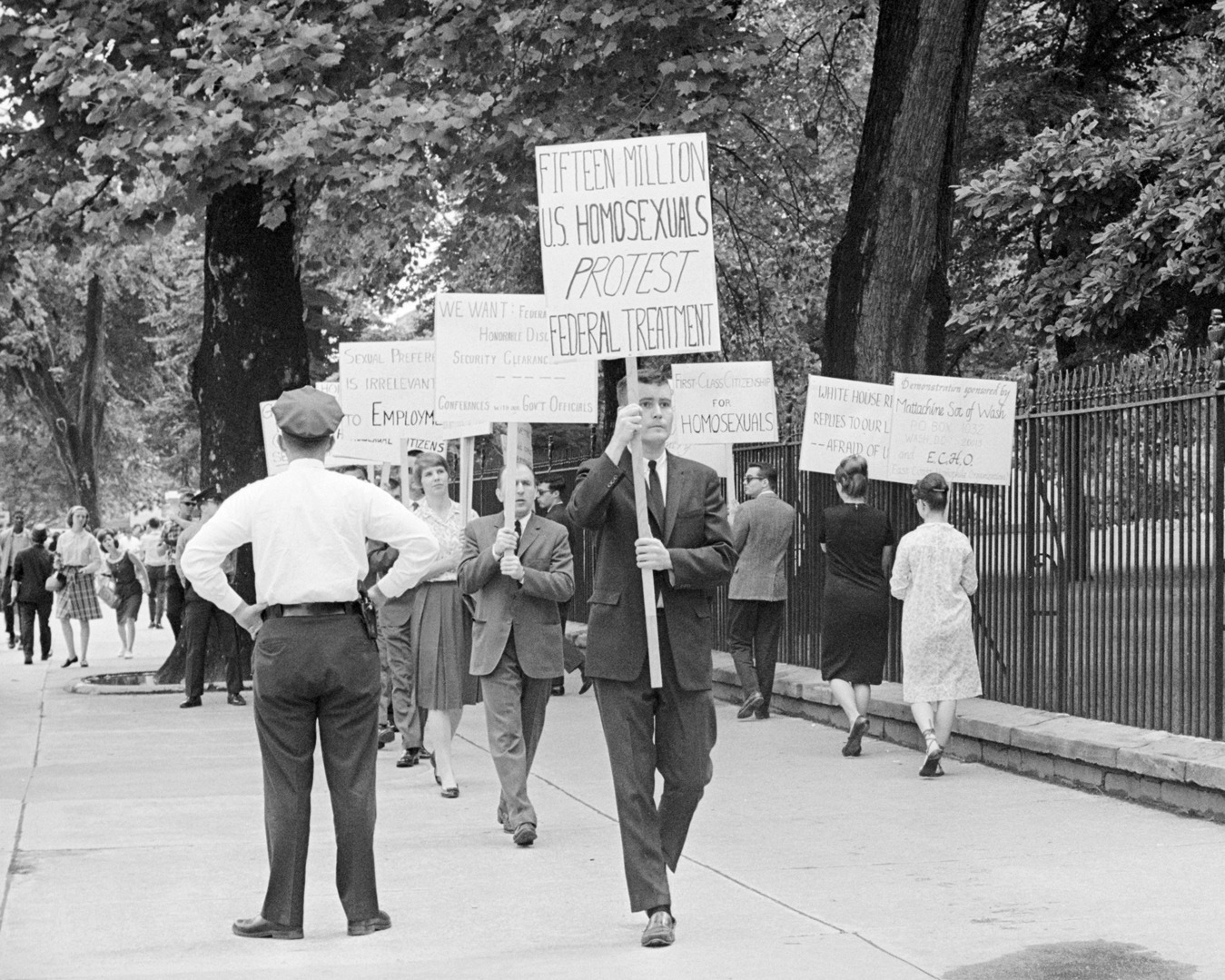
The Mattachine Society Annual Reminder picket, 1967
The second function is spatial. As decades of Pride marches claimed major city streets, they did something more durable than change minds: they changed geography. The community moved from borrowed spaces, clandestine bars, and hidden codes into permanent institutions like community centers, archives, political caucuses, recognized neighborhoods. Visibility is a land claim. It insists on a right to exist in the open daylight, not just after dark.
But the third function — the structural one — is where visibility most often falls short. And the AIDS crisis is the sharpest possible proof.
The Question That Surfaced at Airlie House
By 1987, the LGBTQ+ community was drowning. The AIDS crisis had killed 5,647 people. The Reagan administration had responded with what could only be called deliberate indifference. That October, hundreds of thousands marched on Washington — one of the largest civil rights demonstrations in American history — alongside the first national display of the NAMES Project AIDS Memorial Quilt on the National Mall.
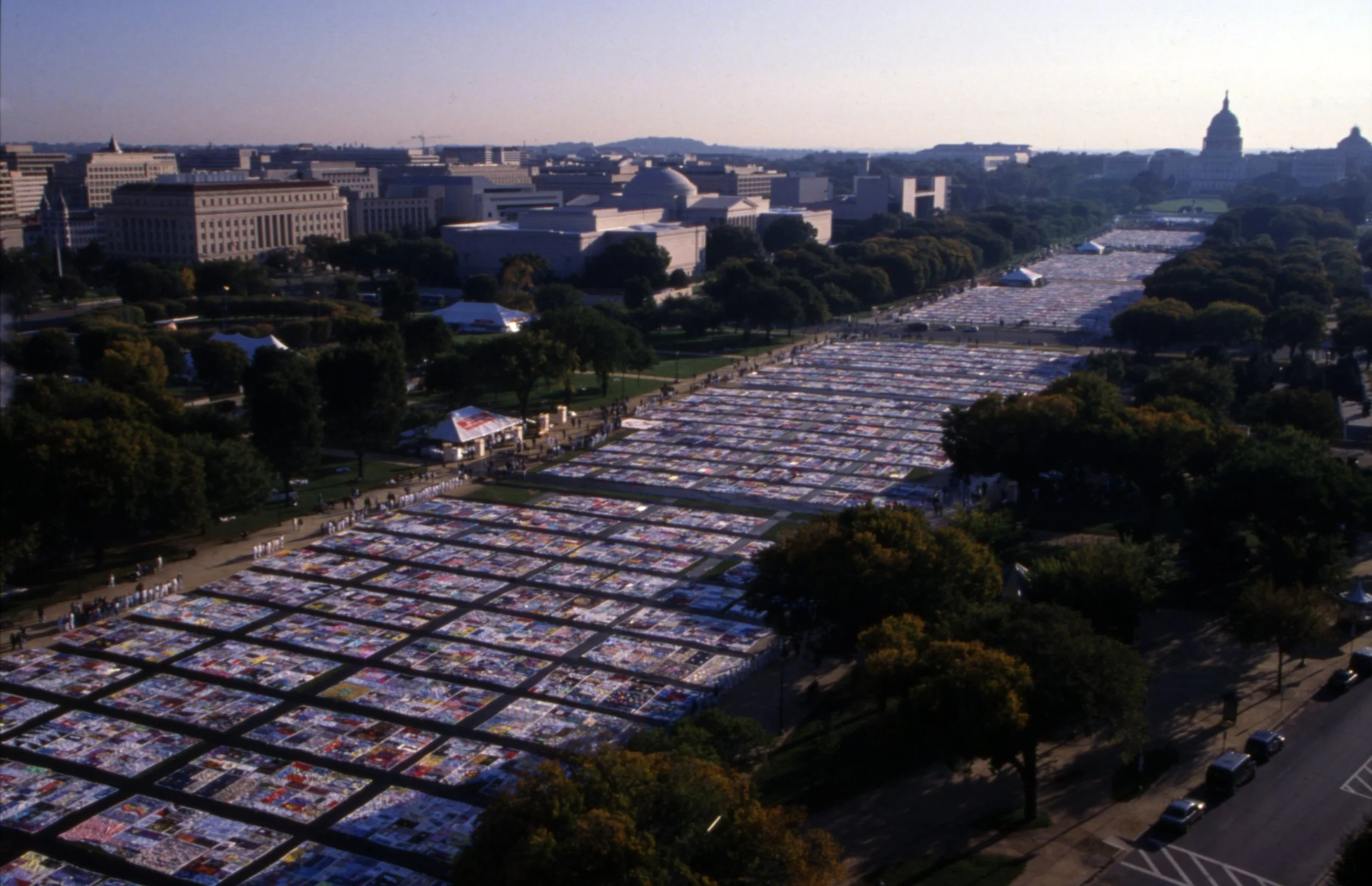
The AIDS Memorial Quilt displayed on the National Mall, October 1996
One Wisconsin participant, twenty-two-year-old Dawn Schmitz, captured the complicated emotional terrain of that weekend: the crowd's power, the media's reductive coverage, and the community's right, which she felt the coverage denied them, to be seen as angry, not only as grieving.
That anger was real and it was justified. But in the months that followed, a harder question emerged. Activist Larry Kramer and some thirty others convened a gathering of roughly two hundred gay and lesbian leaders at Airlie House in Warrenton, Virginia. This was the so-called War Conference of February 1988. The community was fighting for its life. What strategy would actually serve that fight?
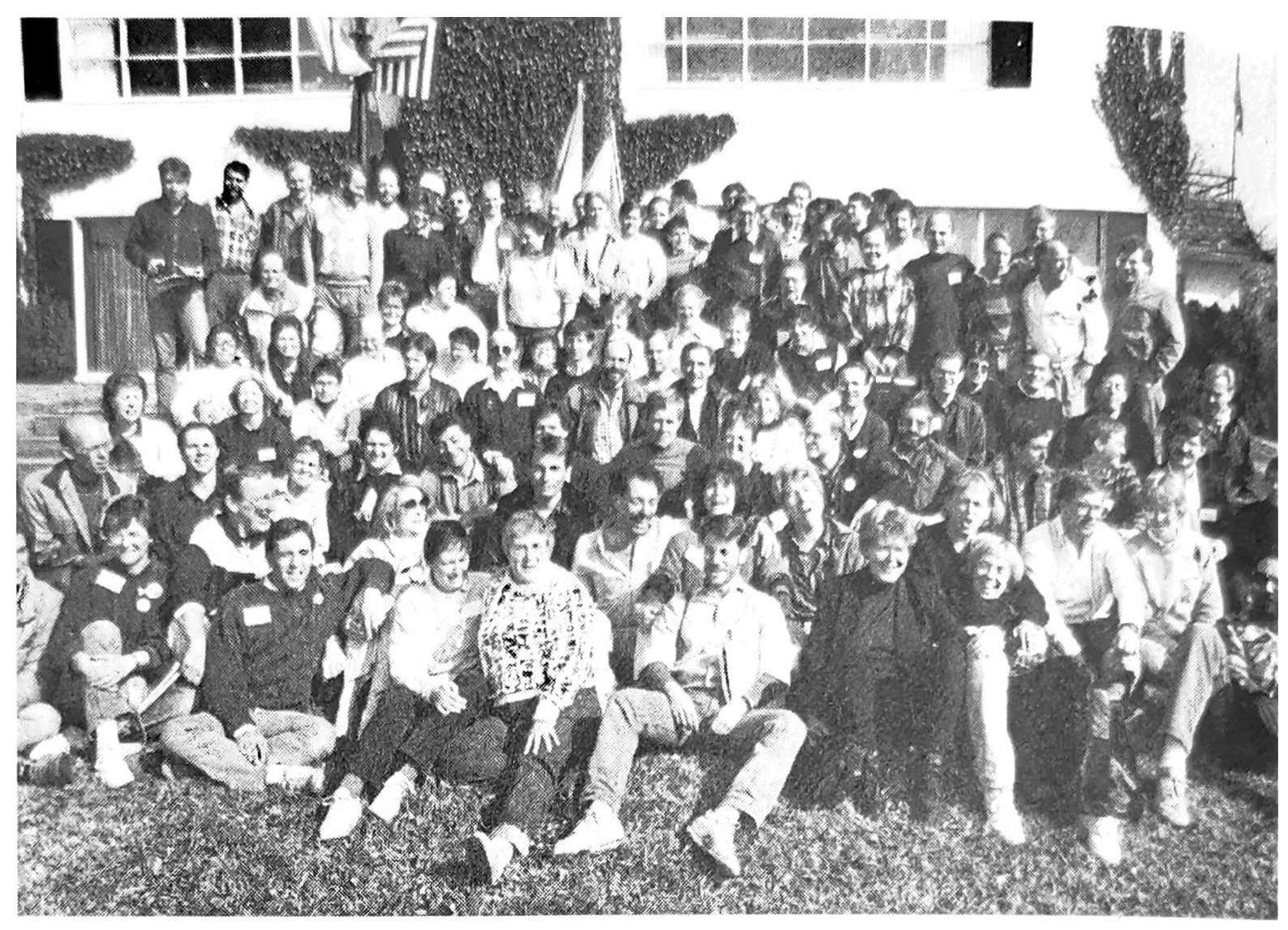
Attendees of the 1987 invitation-only “War conference”
Historian John D'Emilio, who attended the conference, gave voice to the question that haunted it. He wrote afterward about a "constant conference motif": did the movement wanted to build its political strategy on grief? His conclusion was that a politics rooted in terror and rage weakens its proponents more effectively than it weakens an oppressive system. "I would much prefer," he wrote, "that we think our way to success."
This was not a call to abandon anger. It was a call to transmute it.
The War Conference produced four concrete recommendations:
a national media campaign for a positive image;
a national network linking organizations across communities, including ACT UP;
annual gatherings of activists; and
a national Coming Out Day.
Rage, caught and shaped by intention, became infrastructure.
That was the model, but it’s only one part of it.
The Paradox at the Heart of Organizing
Here is the tension that 75 years of history makes impossible to ignore: organizations are inherently conservative (“small c”). Not in the electoral sense, in the structural one. To define an organization is to draw a boundary around it. And a boundary, by definition, includes some people and excludes others. The very thing that makes an organization legible to power, its clarity, its focus, its institutional identity, is the same thing that makes it limiting. Like approaching the judge’s bench in a courtroom, you first have to be recognized by the system in order to address it, and more often than not it takes an organization to be recognizable. This is not an unalloyed evil. But it is not an unquestionable good either. It is a genuine paradox, and pretending otherwise produces exactly the kind of sanitized movement history we should be most suspicious of.
The harm this produces is real and structural. When mainstream gay organizations in the latter half of the 20th century sought to build political coalitions capable of winning legislative battles, they made strategic decisions about whose visibility was politically viable. Trans people, gender-nonconforming people, and those at the most vulnerable intersections of identity were frequently asked — explicitly or implicitly — to wait. To step back. To let the more palatable image lead. This was not simply the result of individual prejudice, though prejudice certainly existed. It was the logic of organizational boundary-drawing taken to its most damaging conclusion: the community got legible to the system, and left some of its own people outside the frame.
The Ecosystem Answer
And yet: the Mattachine Society mattered. The AIDS Resource Center of Wisconsin mattered. The formal organizations that drew those boundaries and made themselves legible to power created something real, that is, a set of established institutions from which the next generation could push further, push back, or push in an entirely different direction.
Because that is what happened. The first movement was formal, cautious, organizational, and that became the ground on which a second movement grew. That second movement was as much a response to the first as it was to the changing sociopolitical climate: the anti-war movement, the women's liberation movement, the Black Power movement, the American Indian Movement; each brought new frameworks, new urgencies, and new people into conversation with LGBTQ+ liberation.
ACT UP emerged from that ferment with a deliberately different strategy: a momentary mindset. Not the long institutional game, but the urgent, disruptive, visible action designed to force a tipping point. They organized die-ins at the FDA and demonstrations at the NIH. They scattered the ashes of people who had died from AIDS on the White House lawn. These were not the actions of an organization trying to be legible to the system. They were the actions of people who had concluded the system would not move without being shaken — as much the gay and lesbian community as society as a whole.
At the same time, artists were doing work that neither the formal organizations nor the street activists could do alone: sustaining people through grief, communicating across conflicting political conversations, holding complexity that institutional messaging could not afford to hold. The AIDS Memorial Quilt was not a policy document. It was more durable as a witness and it’s lasted for generations now.
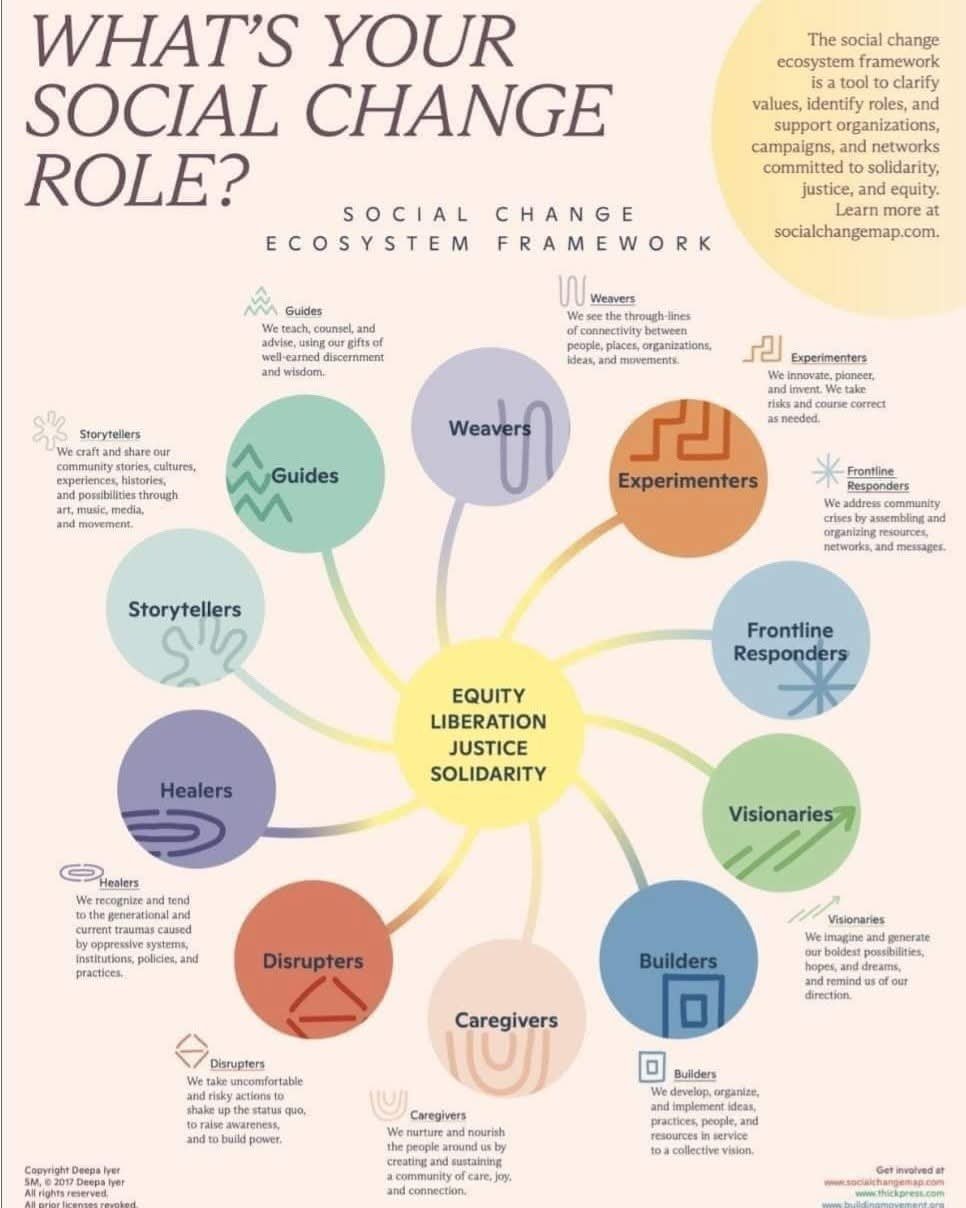
Social Change Ecosystem Map, Deepa Iyer (Building Movement Project), 2017
None of these were the “one simple trick” to social change. None of them, alone, would have been sufficient. But together formal organizations, disruptive direct action, artistic witness, and informal networks constituted something more powerful than any single strategy: an ecosystem. Each element doing what it was best suited to do. Each made more effective by the existence of the others, even when — especially when — they were in tension with each other.
This is not a comfortable framework, because it resists the human desire for a clean answer. There is no single right way to do activism. History does not offer one. What it offers instead is evidence that having many activismS in play at once with some institutional, some radical, some artistic, and some quietly personal is more likely to reach a tipping point than betting everything on one approach. The tipping point, when it comes, is almost never the result of one force. It is the result of forces that have been building, in different registers, for longer than anyone fully tracked.
What This Moment Demands
We are living through another eruption. LGBTQ+ rights are being challenged in legislatures across the country. Young people are being told by institutions that should protect them that their identities are either dangerous or don't exist. The visibility that took 75 years to build is, in some places, being actively dismantled.
The question is not which kind of activism will save us. The question is whether we can sustain the full ecosystem constituted by formal organizations doing the slow institutional work, direct action forcing the tipping points, artists and educators sustaining the community through the long stretches, informal networks connecting people who think they are alone and changing hearts and minds one at a time. Each of these is a form of building. In their own way each is a form of visibility. That’s not just being seen (“look at me”), but creating conditions in which the next person can be seen too (“if you can see me, imagine what you could become”).
The harm of organizational exclusion is real, and the people who were pushed to the margins of a movement they helped build are owed more than acknowledgment. But the story is not over as long as we remain invested in the striving. And the ecosystem, imperfect and tension-filled as it is, offers a more honest map of how change actually moves than any single hero, organization, or moment ever could.
Visibility as Verb
Visibility is not a state of being. It is not something you achieve once and then possess. It is an action. It’s a practice, built and maintained in hard times, especially when the moment is telling you to be afraid or to be quiet.
Seventy-five years of Pride teaches us that the most powerful acts of visibility were never only about being seen. Instead, they were about creating the conditions in which the next person — the one who doesn't know yet that they're not alone — could be seen too. And the one after that.
That work is organizational. It is disruptive. It is artistic. It is educational. It is, in the deepest sense, historical — because it requires understanding where you came from in order to know what you're protecting and what you're still building toward.
This Pride Month, celebrate with programming that honors the full weight of what visibility has cost and what it has made possible. Expanding Horizons' traveling exhibits bring that history into your community — not as decoration, but as one part of a living ecosystem of education, memory, and resistance. Reach out to bring an exhibit home to your community. Explore exhibit options at ExpandingHorizons.LGBT/exhibits.
History is not what happened. It's what we're still doing with it.
