
Why LGBTQ History Month Matters More Than Ever (And How to Observe It Meaningfully)
Every October, schools, libraries, and community organizations face a version of the same question: how do we mark LGBTQ+ History Month in a way that actually means something? No, not another rainbow bulletin board. Also, still not a laminated timeline that comes down on November 1st.
The better answers begin with understanding precisely what is at stake, and what is being lost, when LGBTQ+ history is suppressed, sanitized, or simply left out.
Objects and Subjects
There is a distinction in the way history gets taught that rarely gets named directly, but which shapes everything about how students understand their place in the world. It is the distinction between being an object of history and being a subject of it.
Objects of history are the people things happen to. They appear in the narrative as victims, as populations, as problems to be solved or ignored. Their presence in the historical record is contingent on someone else’s decision to include them. They have no agency in the telling of their own story.
Subjects of history are the people who act. They organize, resist, create, build, and demand. They shape events rather than simply experiencing them. Their presence in the record reflects their actual role in what happened.
When LGBTQ+ history is taught at all, it is most often taught as object history. LGBTQ+ people appear as the targets of discrimination, the victims of the AIDS crisis, the recipients of rights eventually granted by a more enlightened majority. What gets erased is the record of LGBTQ+ people as subjects: the activists who built organizations, fought legal battles, changed medicine, advanced science, and created the cultural infrastructure that modern life runs on.
Kevin Jennings, CEO of Lambda Legal, has written that when young people are presented with a version of history from which they are completely absent, they have trouble envisioning a positive future for themselves. That observation points at something real. But the damage runs deeper than visibility. When students are trained to understand LGBTQ+ people as objects, as the type of people that events happen to, rather than as agents with their own political organization, their own strategies, their own capacity to reshape the world, then they absorb a distorted picture of both history and possibility. And the distortion is not accidental. It is the mechanism by which a group of people is prepared, psychologically and culturally, for complete erasure.
Have you heard of the Kuleshov effect?
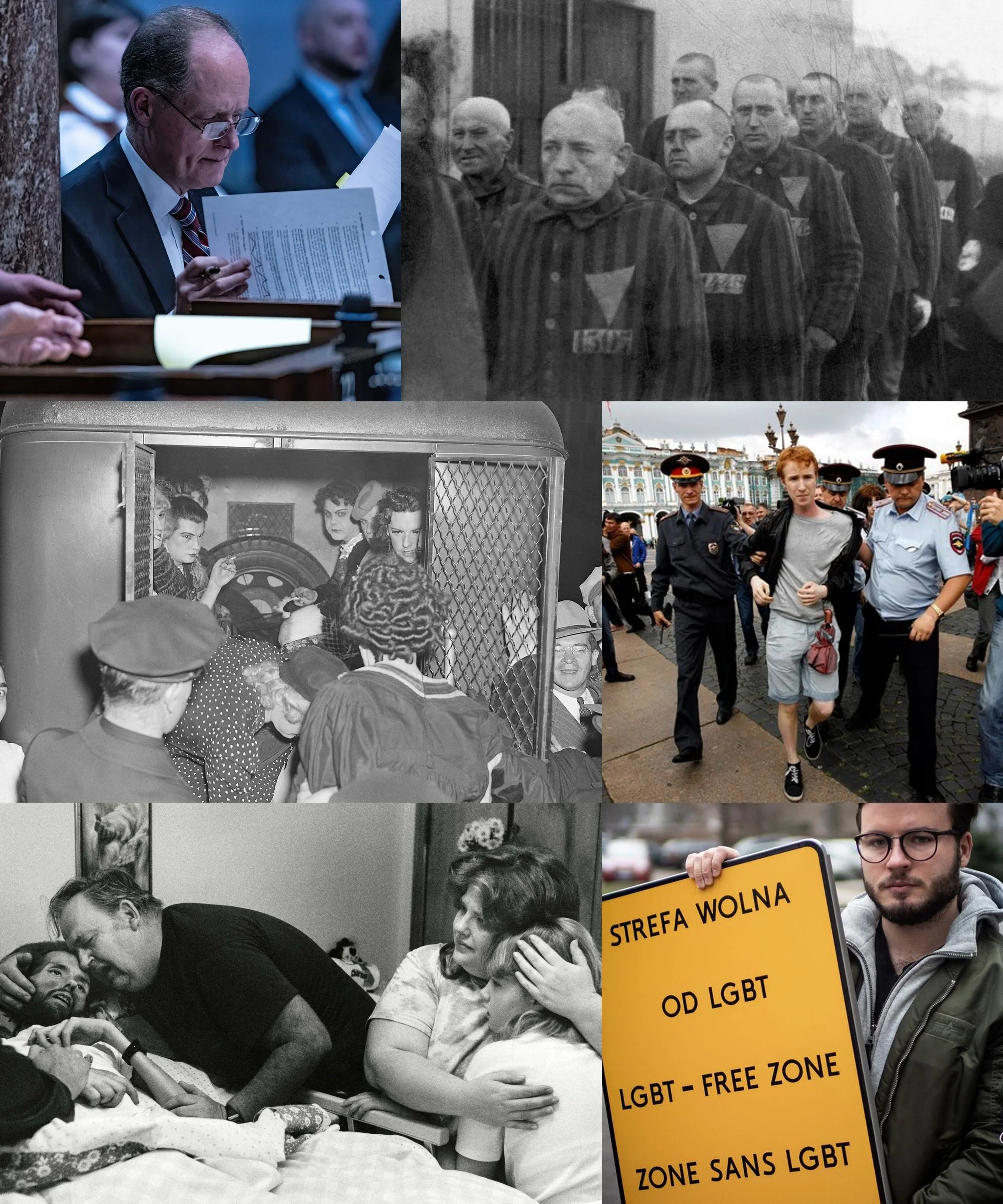
[Top-left] Tennessee Senate Bill 1 was sponsored by Senate Majority Leader Jack Johnson that bans healthcare providers from prescribing puberty blockers and hormone therapy for the treatment of gender dysphoria in United States v. Skrmetti (2025).
[Top-right] Homosexual prisoners wearing pink triangles on their uniforms in the Nazi Sachsenhausen concentration camp (1938).
[Middle-left] New York police lead drag queens arrested at a ball (1963).
[Middle-right] Russian police detain gay-rights activist Kirill Kalugin in St. Petersburg (2013).
[Bottom-left] David Kirby on his deathbed, "the photo that changed the face of AIDS" (1990).
[Bottom-left] Polish activist Bartosz Staszewski, holding an official yet symbolic removed "LGBT-free zone" sign in Swietokrzyskie province, Poland (2021).
A People With No History
There is a reason the tagline of so many social visibility campaigns is, “you can’t be what you can’t see.” Although that formulation captures something true, at Expanding Horizons, we understand that the deeper claim is this: a people with no history have no use for a future.
A people’s loss of access to their own history is not merely limiting the inspirational stories that can be shared. It’s so much more sinister: It is the severing of a community from the record of its own agency, from the proof that it has organized before, won before, survived before, and built things that outlasted the hostility of its own era. That record is the foundation that the next generation of advocates, scientists, artists, and organizers builds upon. Remove it and you won’t just leave young people without role models; you’ll leave them without tools.
There Is Nothing New Under the Sun
Ecclesiastes 1:9 observes that there is nothing new under the sun. With the politics of cultural suppression, this holds with uncomfortable precision!
In 1988, the British Parliament under Margaret Thatcher passed Section 28, a law prohibiting local authorities from “promoting homosexuality” or publishing materials that presented same-sex relationships as acceptable family relationships. The practical effect was a chilling of LGBTQ+ discussion in schools, libraries, and public institutions across the United Kingdom. Teachers self-censored. School counselors went silent. An entire generation of LGBTQ+ young people in Britain came of age in a state-mandated void.
When the U.K. Parliament repealed Section 28 in 2003, it had been law for fifteen years.
The legislative pattern now playing out across American states, laws prohibiting classroom discussion of gender and sexuality, restrictions on library materials, book removals at scale, is not a new invention. This is a template with its own documented history, a documented cost, and a documented endpoint. The argument that children must be protected from LGBTQ+ content was the argument in Westminster in 1988. The framing that LGBTQ+ visibility is itself a form of harm is not a contemporary insight. It has been used, tested, and ultimately rejected before – within living memory – by a democratic society that looked back on it with shame.
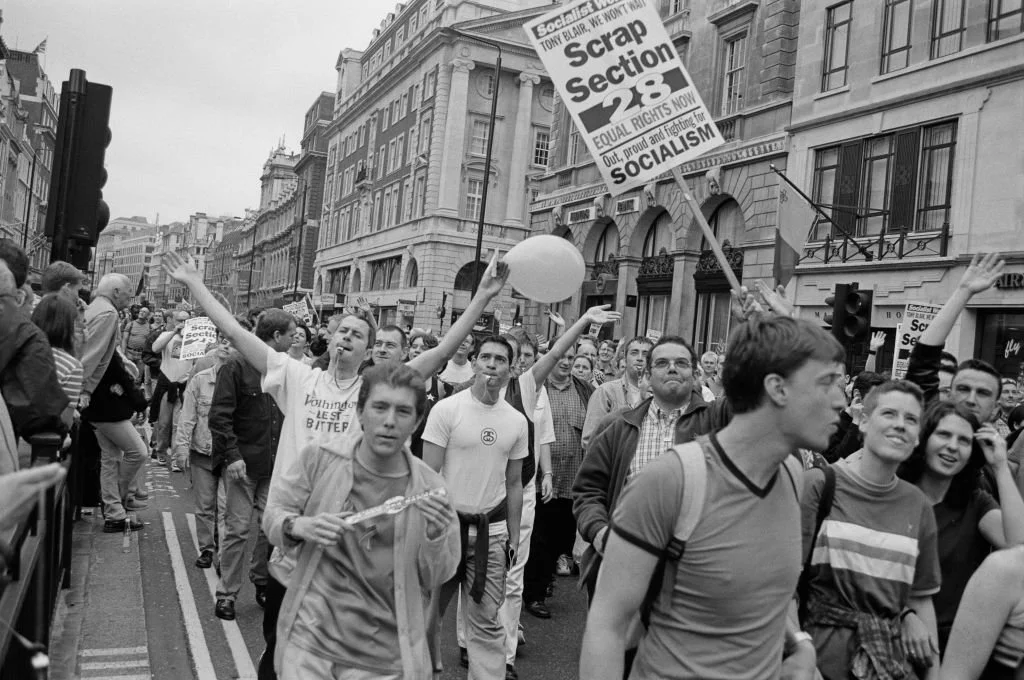
Marchers in Piccadilly on July 4, 1998. (Steve Eason, Hulton Archive/ Getty Images)
Understanding this pattern is precisely what LGBTQ+ History Month exists to enable, creating the map for others (and especially young people) to follow.
The Civilizational Evidence
One of the most persistent and most damaging myths surrounding LGBTQ+ identity is that queer people are, in some sense, a contemporary anomaly — a modern development, a product of recent cultural permissiveness, a deviation from an otherwise stable historical norm.
The historical record refutes this comprehensively. But Expanding Horizons’ Through Science to Justice exhibit goes further than refutation. It makes the affirmative case: that modern civilization is materially built on the contributions of LGBTQ+ people, not just in the arts and entertainment where queer presence is grudgingly acknowledged, but in medicine, public health, scientific research, and technology.
The tuberculosis screening programs that saved tens of thousands of lives were advanced by Alan Hart, a transgender man who practiced medicine at a time when his identity could have ended his career. The public health infrastructure for maternal and child welfare in New York was built by Sara Josephine Baker, who lived outside the bounds of heteronormative expectation. The scientific framework that first distinguished sexual orientation from pathology — paving the way for the APA’s 1973 reclassification of homosexuality — was Evelyn Hooker’s, a woman who designed her landmark study specifically because she believed the prevailing consensus was wrong, and then proved it.
The AIDS crisis shows what institutional denial of this subject history costs in the most direct terms available. When government treated the epidemic as something happening to a population it had already decided didn’t fully matter, tens of thousands of people died of a disease that was biologically manageable before it was politically convenient to manage it. The activists who forced the system to respond — who sat in at the FDA, who marched with the ashes of the dead, who built their own parallel research infrastructure when the official one failed them — were not exceptional individuals rising above their circumstances. They were a community drawing on a long tradition of organized resistance that the history books had mostly chosen not to teach.
That tradition is LGBTQ+ history. It belongs in every classroom, every library, and every community that claims to take education seriously.
What Meaningful Observance Actually Looks Like
LGBTQ+ History Month is observed meaningfully when it treats LGBTQ+ history as the documented record of human agency rather than as a catalog of suffering to be acknowledged… and set aside.
That means curriculum that names not just the events but the strategies: how the homophile movement built its infrastructure, how ACT UP forced regulatory change, how lawyers and scientists and organizers worked across institutions to shift what was legally and medically possible. It also means programming that connects that subject history to the present tense. There are now legislative battles, research priorities, and community organizations that are direct descendants of the movements students are learning about from the past.
This means ensuring that this programming is not a one-month installation that gets rolled up on October 31st. LGBTQ+ History Month should be a catalyst, not a container! The most effective observances use it to launch something that stays. Imagine a permanent section of the school library, a community partnership, an ongoing educational program that treats queer history as an integral part of American history rather than a supplemental topic.
The history has always been there. The question is whether the institutions charged with teaching it are ready to teach it honestly, as the story of people who acted, built, organized, and refused to be erased.
That is a story worth telling all year; still, October is a good time to start.
Bring LGBTQ+ History Month to life in your community with traveling exhibits designed to educate, challenge, and inspire. Contact Vince at vince@ExpandingHorizons.LGBT or explore the full catalog at ExpandingHorizons.LGBT/exhibits.
A people with no history have no use for a future. Give them both.
