
Through Science to Justice: How Medical History Shaped LGBTQ+ Rights
In 1919, a German Jewish physician named Magnus Hirschfeld co-wrote and appeared in a silent film called Anders als die Andern (Different from the Others) one of the first motion pictures to depict gay love without condemnation. Near the film’s end, Hirschfeld appears as a doctor delivering a monologue to a young man in crisis. The intertitles record his words: You must keep living; live to change the prejudices by which this man has been made one of the countless victims. Through science to justice!
The film was nearly eradicated by the Nazis, though fragments survived.
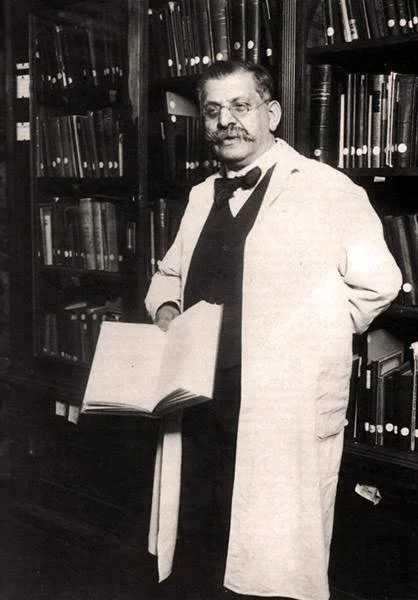
Magnus Hirschfeld
That phrase, “through science to justice,” is the title of one of Expanding Horizons’ traveling exhibits, but it’s more than a slogan. It’s a thesis drawn from more than a century of evidence: that the medical establishment’s relationship to LGBTQ+ people has been one of the most consequential and most underexamined forces in the history of civil rights.
Before the Science, There Was the Harm
To understand what the science corrected, you have to understand what medicine had been doing before it corrected itself. Through the early and mid-twentieth century, the American medical and psychiatric establishment classified homosexuality as a mental disorder — a position that had enormous downstream consequences. It was the scientific legitimacy of that classification that justified conversion practices, institutionalization, and the social and legal machinery that treated LGBTQ+ people as inherently disordered.
It was consensus, not fringe medicine, and it was wrong.
Evelyn Hooker and the Study That Changed Everything
In 1953, a psychologist named Evelyn Hooker applied for a grant from the National Institute of Mental Health to study what she called “normal homosexuals” at a time when that phrase was widely considered an oxymoron. She recruited thirty gay men and thirty heterosexual men, matched for age, IQ, and education, none of whom were in therapy. She administered standard psychological assessments, then turned the results over to a panel of three expert judges who did not know which subjects were gay.
The judges could not tell the difference. The experiment found that homosexuality was not a mental disorder, as there was no detectable difference between homosexual and heterosexual men in terms of mental adjustment.
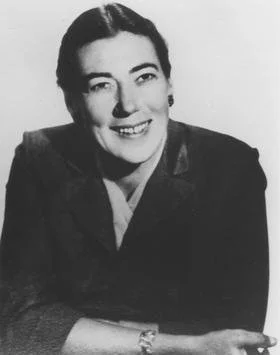
Evelyn Hooker: “Homosexuals are well adjusted. Change my mind.”
Hooker presented her findings at the 1956 American Psychological Association convention in Chicago. A variety of medical and psychological treatments to “cure” homosexuality were in use at the time, including ice pick lobotomies, electroshock, and chemical castration. Her findings didn’t end those practices overnight. But they cracked the scientific foundation on which those practices rested. It would be another seventeen years before the American Psychiatric Association removed homosexuality from its Diagnostic and Statistical Manual’s list of mental illnesses, but it was Hooker’s study that made the eventual decision scientifically inevitable.
The AIDS Crisis and the Hidden Meaning of “Previously Healthy”
On June 5, 1981, the CDC published a brief report in its Morbidity and Mortality Weekly Report describing an unusual cluster of cases: five young, previously healthy gay men in Los Angeles presenting with Pneumocystis pneumonia, an infection that rarely causes serious illness in healthy adults. It was the first official account of what would become the AIDS epidemic.
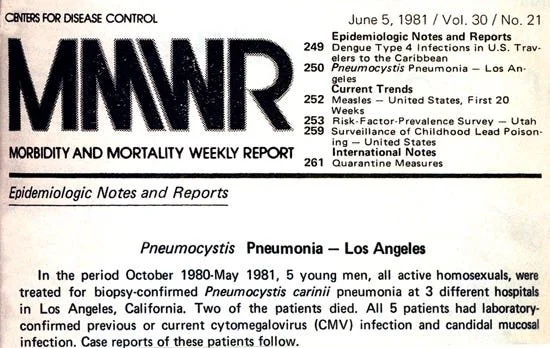
Those two words — previously healthy — are doing more work than they appear to.
Sociologist and historian Cindy Patton, in her 1990 book Inventing AIDS, offers a pointed observation about that phrasing. The emerging syndrome was defined specifically as immune malfunction in previously healthy people. The rapid decline that set the CDC into motion was noticeable precisely because the affected patients had been considered healthy. And the reason gay men in these coastal urban centers were considered healthy (rather than constitutionally weakened or morally compromised) was that medical culture in those communities had, by 1981, moved far enough from pathologization to evaluate gay patients on the same terms as anyone else. Patton argues that fifty years earlier, that same immune dysfunction would likely have been attributed to the homosexuality itself, and the epidemic might never have been identified as a distinct syndrome.
This is science shaping justice in reverse. Or, rather, it is a glimpse of how profoundly the relationship between medicine and a marginalized community determines what gets seen, what gets named, and what gets addressed.
Two Physicians Who Changed What Medicine Could Look Like
The Through Science to Justice exhibit doesn’t trace the institutions, though, it traces the people who navigated them, often at great personal cost.
Alan Hart, MD, MS, MPH
Dr. Alan Hart is recognized as one of the first people in the United States to undergo gender-affirming surgery, in 1917. He went on to earn a medical degree and became a pioneering radiologist and public health researcher whose work advancing mobile X-ray screening for tuberculosis improved outcomes for countless patients who never knew his name or his history. Hart practiced medicine as himself, in an era that had no framework for what he was and significant legal exposure for anyone who did.
Sara Josephine Baker, MD, DrPH
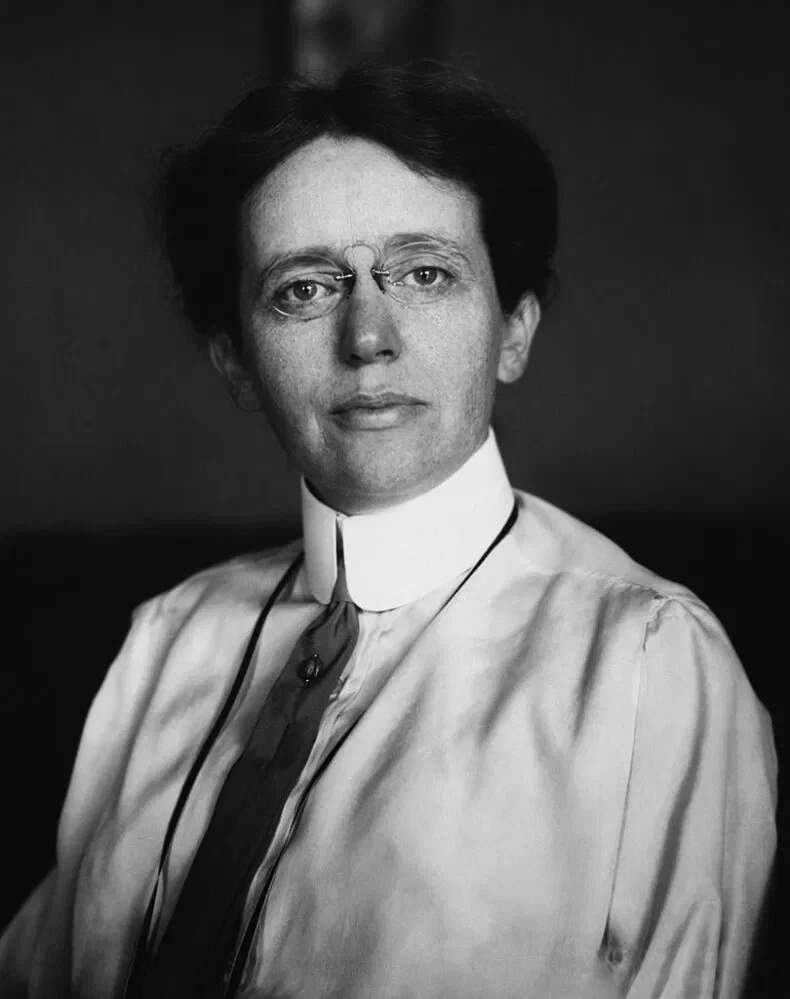
Sara Josephine Baker
Sara Josephine Baker, a physician and public health leader in early twentieth-century New York, became the first director of the city’s Bureau of Child Hygiene and built some of the most consequential preventive care systems in American history. Her personal life (she lived for many years with the writer Ida Wylie in what historians often situate within the history of lesbian and queer communities) was largely invisible to the public she served. Her public health legacy is not contingent on that history, but her presence in LGBTQ+ history is a reminder that the people who built American medicine were not the monolith the institutions presented.
Why This Matters for Universities and Medical Institutions
The relationship between science and LGBTQ+ rights is not ancient history. It is living institutional memory: medical schools whose predecessors administered electroshock as a “cure;” psychiatric institutions that classified gender dysphoria as disorder long after the evidence argued otherwise; research frameworks that made LGBTQ+ people invisible, or made them visible only as pathology.
That history has consequences for clinical training, patient trust, and institutional culture that are still playing out today. LGBTQ+ patients, and particularly trans patients and QTPOC patients, present with documented health disparities rooted in part in avoidance of a medical system that has historically harmed them. Understanding that history is clinical competency, not a courtesy.
Through Science to Justice brings stories of LGBT people in STEM — many in medical fields — into a format that works for grand rounds, health sciences libraries, student unions, and campus LGBTQ+ resource centers alike. It is, as Hirschfeld intended, an argument: that rigorous inquiry and human dignity are not in tension. That the obligation of science is not just to describe the world but to make it more just.
Bring Through Science to Justice to your university, medical school, or healthcare institution. Contact us or explore the full exhibit catalog at ExpandingHorizons.LGBT/exhibits.
The science has spoken. The work of justice is ongoing.
